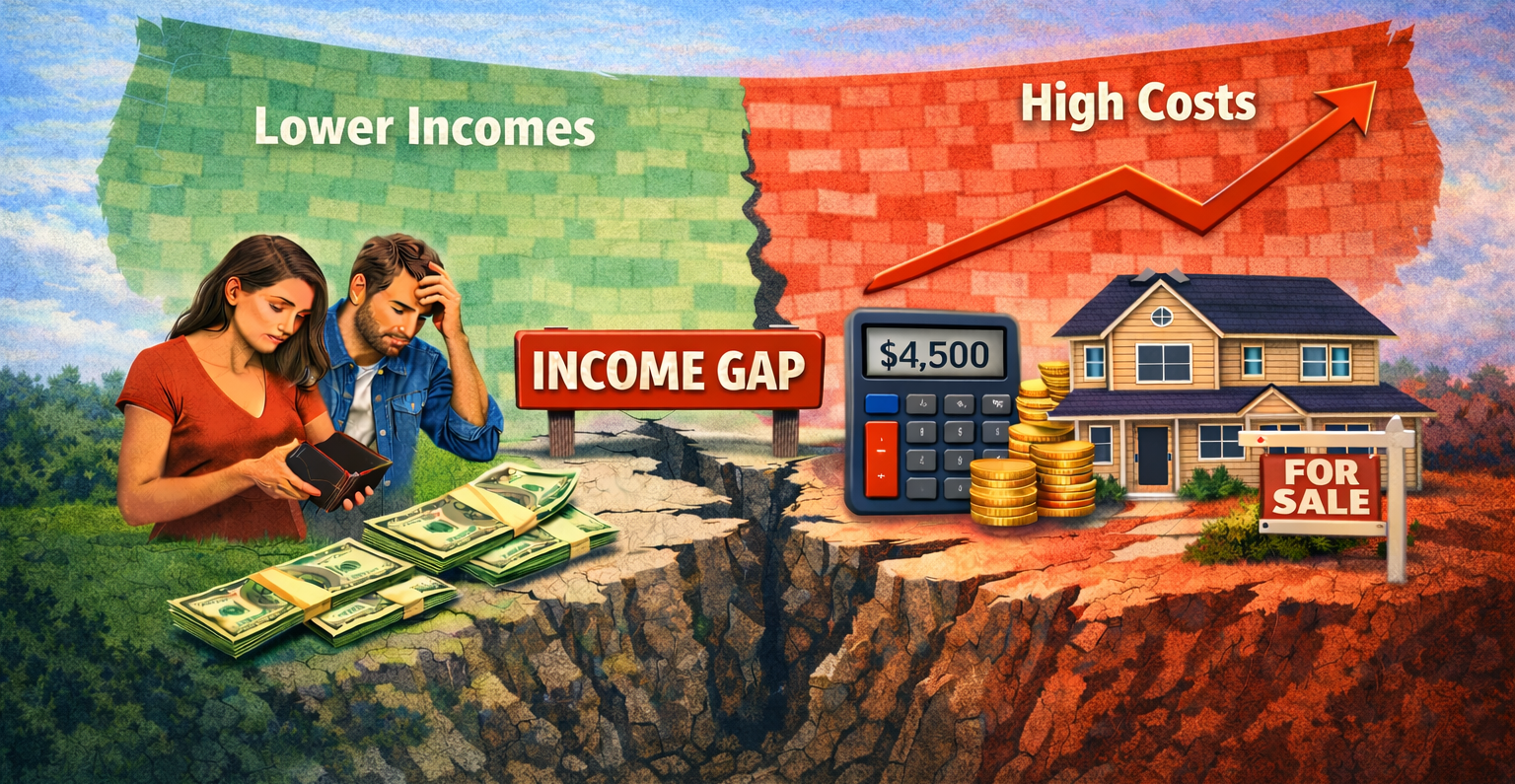
Buying a home in America increasingly feels like a math problem that doesn’t add up.
Home prices are still high. Mortgage rates remain elevated. And for millions of households, incomes simply haven’t kept pace.
To understand how wide that gap really is, we looked at what it actually costs to buy a typical home in every U.S. state and then compared it to what households actually earn.
In the latest edition of Profit Trends, we dug into the data to see where homeownership is still within reach — and where the numbers are pushing it further out of sight. The results reveal a striking divide between states where incomes still cover the cost of buying a home and those where the gap has grown too wide to ignore.
Some states may surprise you. Others may confirm what homeowners and buyers have been feeling for years. Read on to see how your state stacks up.
Contents
- What the Data Reveals
- Top and Bottom of the List
- The 10 Least Affordable States for Homebuyers
- The 10 Most Affordable States for Homebuyers
- Methodology
1. What the Data Reveals
We based our findings on a 16% down payment and a 30-year fixed-rate loan, using average interest rates. Data was collected from Zillow to determine average home values, and Zillow’s mortgage calculator was used to estimate monthly mortgage payments.
Our analysis shows that in 30 out of 50 states, the median household income is not high enough to afford the average home value under the widely used “30% rule,” which recommends spending no more than 30% of gross income on housing.
- Alabama
- Alaska
- Arizona
- Arkansas
- California
- Colorado
- Connecticut
- Delaware
- Florida
- Georgia
- Hawaii
- Idaho
- Illinois
- Indiana
- Iowa
- Kansas
- Kentucky
- Louisiana
- Maine
- Maryland
- Massachusetts
- Michigan
- Minnesota
- Mississippi
- Missouri
- Montana
- Nebraska
- Nevada
- New Hampshire
- New Jersey
- New Mexico
- New York
- North Carolina
- North Dakota
- Ohio
- Oklahoma
- Oregon
- Pennsylvania
- Rhode Island
- South Carolina
- South Dakota
- Tennessee
- Texas
- Utah
- Vermont
- Virginia
- Washington
- West Virginia
- Wisconsin
- Wyoming
2. Top and Bottom of the List
The Least Affordable
Hawaii stands out as the least affordable state for homeowners, with a housing market far beyond what most residents can sustain. The average home value in Hawaii is over $824,000, pushing the typical monthly mortgage payment to nearly $4,900.
To stay within the standard affordability threshold, a household would need to earn around $197,000 per year - almost double the state’s median household income of $100,745. This creates the largest affordability gap in the USA, leaving many residents priced out of homeownership.
Several factors drive Hawaii’s high costs, including limited developable land, high construction and shipping expenses, as well as significant demand from out-of-state buyers seeking vacation or investment properties.
These pressures reflect a broader national pattern in which home prices and mortgage rates have risen faster than incomes, but in Hawaii the mismatch is especially stark. As a result, these structural limitations and economic pressures work together to push homeownership increasingly out of reach.
3. The 10 Least Affordable States for Homebuyers
1. Hawaii
- Median home price: $824,731
- Median household income: $100,745
- Minimum income to afford median-priced home: $196,720
- Affordability gap: -$95,975
Recommended vs. Actual Income (% Difference): -51.2%
2. California
- Median home price: 761,003
- Median household income: 100,149
- Minimum income to afford median-priced home: $182,680
- Affordability gap: -$82,531
- Recommended vs. Actual Income (% Difference): -45.2%
3. Massachusetts
- Average home price: $645,115
- Median household income: $104,828
- Minimum income to afford median-priced home: $157,200
- Affordability gap: -$52,372
- Recommended vs. Actual Income (% Difference): -33.33%
4. Washington
- Average home price: $591,536
- Median household income: $99,389
- Minimum income to afford median-priced home: $145,400
- Affordability gap: – $46,011
- Recommended vs. Actual Income (% Difference): -31.64%
5. Montana
- Average home price: $457,278
- Median household income: $75,340
- Minimum income to afford median-priced home: $111,320
- Affordability gap: -$35,980
- Recommended vs. Actual Income (% Difference): -32.32%
6. New York
- Average home price: $505,608
- Median household income: $85,820
- Minimum income to afford median-priced home: $121,680
- Affordability gap: -$35,860
- Recommended vs. Actual Income (% Difference): -29.47%
7. New Jersey
- Average home price: $559,826
- Median household income: $104,294
- Minimum income to afford median-priced home: $138,400
- Affordability gap: -$34,106
- Recommended vs. Actual Income (% Difference): -24.65%
8. Oregon
- Average home price: $493,884
- Median household income: $85,220
- Minimum income to afford median-priced home: $119,200
- Affordability gap: -$33,980
- Recommended vs. Actual Income (% Difference): -28.48%
9. Colorado
- Average home price: $535,778
- Median household income: $97,113
- Minimum income to afford median-priced home: $127,840
- Affordability gap: -$30,727
- Recommended vs. Actual Income (% Difference): -24%
10. Utah
- Average home price: $530,173
- Median household income: $96,658
- Minimum income to afford median-priced home: $126,840
- Affordability gap: $-30,182
- Recommended vs. Actual Income (% Difference): -23.8%
4. The 10 Most Affordable States for Homebuyers
1. Iowa
- Average home price: $227,232
- Median household income: $75,501
- Minimum income to afford median-priced home: $61,920
- Affordability gap: $13,581
- Recommended vs. Actual Income (% Difference): 21.93%
2. Mississippi
- Average home price: $186,446
- Median household income: $59,127
- Minimum income to afford median-priced home: $45,680
- Affordability gap: $13,447
- Recommended vs. Actual Income (% Difference): 29.45%
3. Kansas
- Average home price: $237,409
- Median household income: $75,514
- Minimum income to afford median-priced home: $64,040
- Affordability gap: $11,474
- Recommended vs. Actual Income (% Difference): 17.92%
4. West Virginia
- Average home price: $169,372
- Median household income: $60,789
- Minimum income to afford median-priced home: $50,080
- Affordability gap: $10,709
- Recommended vs. Actual Income (% Difference): 21.39%
5. Illinois
- Average home price: $279,761
- Median household income: $83,211
- Minimum income to afford median-priced home: $74,000
- Affordability gap: $9,211
- Recommended vs. Actual Income (% Difference): 12.45%
6. Ohio
- Average home price: $237,530
- Median household income: $72,212
- Minimum income to afford median-priced home: $64,120
- Affordability gap: $8,092
- Recommended vs. Actual Income (% Difference): 12.62%
7. Oklahoma
- Average home price: $214,563
- Median household income: $66,148
- Minimum income to afford median-priced home: $59,400
- Affordability gap: $6,748
- Recommended vs. Actual Income (% Difference): 11.36%
8. Nebraska
- Average home price: $269,423
- Median household income: $76,376
- Minimum income to afford median-priced home: $71,800
- Affordability gap: $4,576
- Recommended vs. Actual Income (% Difference): 6.37%
9. Indiana
- Average home price: $248,442
- Median household income: $71,959
- Minimum income to afford median-priced home: $67,400
- Affordability gap: $4,559
- Recommended vs. Actual Income (% Difference): 6.76%
10. North Dakota
- Average home price: $278,677
- Median household income: $77,871
- Minimum income to afford median-priced home: $73,880
- Affordability gap: $3,991
- Recommended vs. Actual Income (% Difference): 5.4%
Methodology
To evaluate homeownership affordability across all 50 U.S. states, ProfitDuel conducted a comparative analysis using standardized housing, mortgage, and income metrics.
The goal was to determine how much income a household would need to afford the average home in each state under the nationally accepted “30% rule,” and then compare that requirement with actual median household incomes.
1. Data Sources
- Average Home Value:
State-level average home values were collected from Zillow’s Home Values Index database (https://www.zillow.com/home-values). - Mortgage Payment Estimates:
Monthly mortgage payments were calculated using the Zillow Mortgage Calculator (https://www.zillow.com/mortgage-calculator/) with consistent inputs across all states. - Median Household Income:
Median household income for each state was sourced from the United States Census Bureau’s data portal, data.census.gov.
2. Assumptions Used for Mortgage Calculations
To ensure comparability across states, the following fixed assumptions were applied:
- Down Payment: 16%
- Loan Program: 30-year fixed-rate mortgage
- Interest Rate: Average mortgage rates at the time of analysis (as provided within Zillow's calculator).
- Affordability Standard: Housing costs should not exceed 30% of gross household income, in line with the 30% rule commonly used by economists, HUD, and mortgage lenders.
3. Calculating Monthly and Yearly Payments
For each state, the average home value was entered into the Zillow Mortgage Calculator using the assumptions above. This produced:
- Monthly Payment - which included principal and interest (and other standard costs as reflected in Zillow’s calculator).
- Yearly Payment - calculated as: Yearly Payment = Monthly payment x 12
4. Calculating Required Gross Income
To determine how much income a household would need to afford the monthly mortgage payment while staying within the 30% affordability threshold, ProfitDuel used the formula:
Required Gross Income= (Monthly Payment x 12) / 0.30
This represents the minimum annual income needed for the mortgage to remain within the recommended 30% of gross household income.
5. Measuring the Affordability Gap
Two key metrics were developed to assess affordability:
Affordability Difference ($)
Affordability Difference = Median Household Income - Required Gross Income
A positive value indicates the state’s median household income exceeds what is needed to comfortably afford the average home.
A negative value shows the opposite - the median income falls short.
Affordability Gap (%)
This percentage expresses how far above or below the required income the typical household stands:
Affordability Gap (%) = (Median Household Income - Required Gross Income / Required Gross Income) x 100
6. Ranking States
States were ranked from most affordable to least affordable based on the Affordability Gap (%).
- A positive gap reflects states where incomes outpace housing costs.
- A negative gap highlights states where residents would need substantially higher incomes to meet standard affordability criteria.
The resulting rankings, along with all derived metrics - including monthly payments, yearly payments, required incomes, affordability gaps, and differences - are presented in the full dataset.



.png?width=50&height=50&name=download%20(1).png)