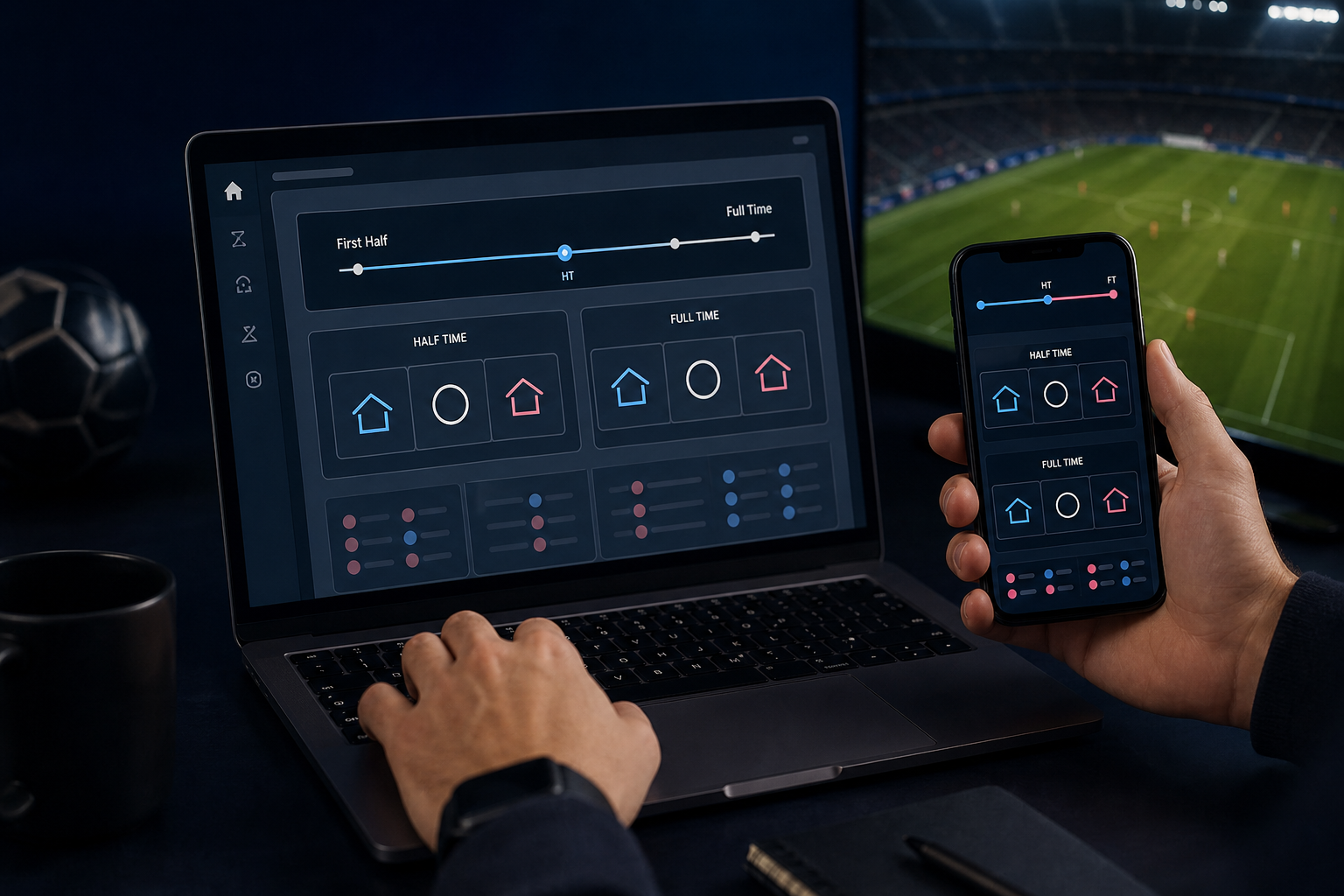
An X/Y match in betting usually refers to a soccer Halftime/Fulltime wager.
The notation combines two results:
- The first symbol represents the result at halftime.
- The second symbol represents the result at fulltime.
In standard soccer betting notation:
- 1 = Home team
- X = Draw
- 2 = Away team
So:
X/1 = Draw at halftime / Home team wins at fulltime
X/X = Draw at halftime / Draw at fulltime
X/2 = Draw at halftime / Away team wins at fulltime
Unlike a normal match-winner bet, both parts of the selection must be correct for an X/Y-style halftime/fulltime wager to win.
Quick Answer: What Does X/Y Mean in Betting?
X/Y notation in betting usually describes a halftime/fulltime result.
The first character shows what the result needs to be at halftime, while the second shows what the result needs to be at the end of regulation.
For example:
|
Selection |
Halftime Result |
Fulltime Result |
|
X/1 |
Draw |
Home win |
|
X/X |
Draw |
Draw |
|
X/2 |
Draw |
Away win |
|
1/2 |
Home leading |
Away win |
|
2/1 |
Away leading |
Home win |
This is different from fractional odds such as 5/2.
An X/Y-style selection describes a sequence of results, not the price of the bet.
What Do 1, X and 2 Mean in Soccer Betting?
Before you can understand X/Y betting, it helps to know the standard 1X2 market.
A traditional soccer 1X2 market has three outcomes:
|
Symbol |
Meaning |
|
1 |
Home team wins |
|
X |
Draw |
|
2 |
Away team wins |
This convention is widely used in soccer betting.
For example, imagine Inter Miami is playing LA Galaxy, with Inter Miami at home.
A standard 1X2 market means:
- 1: Inter Miami wins.
- X: The match finishes tied.
- 2: LA Galaxy wins.
For US bettors, this is essentially a three-way moneyline.
The Action Network describes the same three-way soccer market as Home, Draw and Away, with the draw represented by X in 1X2 notation.
How Does an X/Y Bet Work?
An X/Y-style wager combines two separate match states into one selection.
Both need to happen.
Suppose you bet:
X/2
That means:
- The match must be tied at halftime.
- The away team must win by fulltime.
If the match is tied at halftime but the home team eventually wins, your wager loses.
If the away team is already winning at halftime and goes on to win the game, your wager still loses.
Why?
Because the first condition — draw at halftime — didn't happen.
That extra condition is why halftime/fulltime markets will generally offer longer odds than simply backing one team to win the match.
What Does X/1 Mean in Betting?
X/1 means Draw/Home.
The match must be tied at halftime, then the home team must win by fulltime.
For example:
Halftime: 0-0
Fulltime: 2-0
That would be a winning X/1 bet.
Another example:
Halftime: 1-1
Fulltime: 2-1
Again, X/1 wins.
The precise score doesn't matter.
What matters is:
Halftime = Draw
Fulltime = Home win
What Does X/X Mean in Betting?
X/X means Draw/Draw.
The match must be level at halftime and also level at fulltime.
For example:
Halftime: 0-0
Fulltime: 1-1
The wager wins.
Another possible winner would be:
Halftime: 1-1
Fulltime: 2-2
The scores can change.
The important condition is that both checkpoints are draws.
What Does X/2 Mean in Betting?
X/2 means Draw/Away.
The game must be tied at halftime before the away team wins the match.
For example:
Halftime: 1-1
Fulltime: 1-3
That would be a winning X/2 wager.
However:
Halftime: 0-1
Fulltime: 0-2
would lose.
The away team won the match, but the game wasn't tied at halftime.
What Are All the Halftime/Fulltime Betting Combinations?
A standard soccer halftime/fulltime market has nine possible outcomes:
|
Selection |
Halftime |
Fulltime |
|
1/1 |
Home |
Home |
|
1/X |
Home |
Draw |
|
1/2 |
Home |
Away |
|
X/1 |
Draw |
Home |
|
X/X |
Draw |
Draw |
|
X/2 |
Draw |
Away |
|
2/1 |
Away |
Home |
|
2/X |
Away |
Draw |
|
2/2 |
Away |
Away |
Sportsbooks may write these out as:
Draw/Home
or simply:
X/1
The underlying selection is the same.
Expert Insight: Read the Market Name Before Reading the Slash
The slash itself doesn't tell you what kind of wager you're looking at.
For example:
1/2
could mean a halftime/fulltime selection.
But:
5/2
could be fractional odds.
The market heading gives you the context.
If the sportsbook says:
Halftime/Fulltime
then the symbols describe the match result at two different stages.
If the sportsbook is displaying:
5/2, 3/1, 7/4
alongside other prices, you're probably looking at fractional odds.
Always identify the market before interpreting the notation.
X/Y Betting Example
Imagine Austin FC is playing Seattle Sounders.
You expect the first half to be cautious but think Seattle will eventually win.
You select:
X/2
That means:
Halftime: Draw
Fulltime: Seattle win
Suppose the game finishes:
Halftime: 0-0
Fulltime: 0-2
Your X/2 bet wins.
But suppose Seattle scores after 20 minutes and ultimately wins 2-0.
The bet loses because Seattle was already leading at halftime.
That's what makes an X/Y bet more specific than a standard fulltime winner wager.
Is X/Y the Same as 1X2 Betting?
No.
They're related, but they're different markets.
1X2 Betting
A standard 1X2 bet only asks which of three results will occur at the end of the relevant match period:
- Home win.
- Draw.
- Away win.
In soccer, this is commonly described as a three-way moneyline.
Halftime/Fulltime Betting
A halftime/fulltime bet requires you to predict two results.
For example:
X/2
requires:
Draw at halftime AND away team wins at fulltime.
Because your selection needs two separate conditions to occur, it is a more specific wager.
Data Insight: Why 1X2 Has Three Outcomes
Soccer differs from many major US sports because matches can end in a draw after regulation.
That's why standard soccer moneylines often contain three options rather than two.
The Action Network's soccer betting guide describes a three-way moneyline as:
- Home.
- Draw.
- Away.
The same structure is represented internationally as:
1 / X / 2
That three-result structure is what allows halftime/fulltime combinations such as X/1, X/X and X/2 to exist.
Is X/Y the Same as Fractional Odds?
No.
This is one of the easiest areas to get confused.
A sportsbook might show:
5/2
as fractional betting odds.
That is completely different from:
X/2
in a halftime/fulltime market.
What Does 5/2 Mean?
Fractional odds show the potential profit relative to your stake.
Odds of 5/2 mean you could win $5 in profit for every $2 wagered if the bet succeeds.
Fractional odds are more common in the UK and Ireland than in the US, where American odds such as:
+150
or:
-200
are more familiar.
What Does X/2 Mean?
X/2 isn't an odds format.
It's the actual betting selection:
Draw at halftime / Away win at fulltime
An X/2 selection will then have its own price.
For example:
X/2 at +550
Here:
X/2 = the selection
+550 = the odds
What Does the Slash Mean in Sports Betting?
There isn't one universal meaning.
A slash can represent different things depending on the market.
For example:
5/1
may be fractional odds.
While:
X/1
can describe a halftime/fulltime result.
Even:
1/2
could mean either depending on where it's displayed.
That's why you should always check the sportsbook's market label.
If you see:
Halftime/Fulltime
then the first and second characters describe results.
If you see the fraction among a list of sportsbook prices, it's more likely to be an odds format.
Why Does X Mean a Draw?
The X comes from traditional 1X2 soccer betting notation.
Rather than writing:
Home / Draw / Away
sportsbooks can use:
1 / X / 2
The format is compact and easy to display alongside many fixtures.
For US bettors accustomed to American moneylines, it can look strange initially.
But the shortcut is simple:
1 = Home
X = Draw
2 = Away
Once you know those three symbols, most 1X2 and halftime/fulltime markets become much easier to read.
Are X/Y Bets Only Used in Soccer?
You'll encounter the notation most commonly in soccer.
That's because:
- Draws are a normal fulltime result.
- 1X2 notation is widely used.
- Halftime and fulltime markets are common.
Other sports may offer equivalent double-result or period/full-game markets, but sportsbook terminology can vary.
For example, Betfair uses the term Double Result (Half Time/Full Time) in some sports and settles the wager according to the score at halftime and fulltime.
Always read the market description and sportsbook settlement rules rather than assuming every sport uses identical notation.
Are X/Y Bets Harder to Win?
An X/Y halftime/fulltime wager has more conditions than a standard match-winner selection.
Compare:
Standard Fulltime Bet
Seattle to win
You only need Seattle to win the match.
X/2 Halftime/Fulltime Bet
Draw/Seattle
You need:
- The game to be tied at halftime.
- Seattle to win by fulltime.
Because you're predicting a more specific sequence of events, the sportsbook will generally offer higher odds.
But higher odds don't automatically mean better value.
A longer price simply reflects a less likely combination of results.
Expert Insight: More Conditions Means More Ways to Lose
A bettor may look at an X/2 selection and focus on the attractive payout.
But compare the number of conditions.
For Seattle simply to win, there is one core requirement:
Seattle wins.
For X/2, you need:
The game is tied at halftime AND Seattle wins.
Seattle could still win 3-0 and your X/2 bet could lose because they were ahead at halftime.
That distinction matters when comparing betting markets.
Can You Use X/Y Markets for Matched Betting?
Potentially, but they are not usually the easiest markets to use for matched betting.
Matched betting works by placing carefully calculated wagers across outcomes so that your exposure to the sporting result is reduced while you extract value from a sportsbook promotion.
The challenge with halftime/fulltime bets is that there are nine possible result combinations.
That makes them significantly more complicated to hedge than a simple two-outcome moneyline.
For example:
Sportsbook A: X/2 Halftime/Fulltime
and:
Sportsbook B: Home moneyline
do not automatically oppose each other.
There are numerous scenarios where both bets could lose.
If you're learning how matched betting works, simpler markets are generally easier to understand and calculate.
Why Matching the Exact Market Matters
One of the most important principles in matched betting is that two wagers aren't necessarily opposites simply because they're on the same sporting event.
Take:
X/2 Halftime/Fulltime
and:
Home to win
These are different markets.
Suppose the home team is winning at halftime but the away team comes back to win.
Your X/2 wager loses because the match wasn't level at halftime.
Your home win wager also loses because the away team won.
You've therefore failed to cover the result.
Before treating two sportsbook wagers as opposing positions, check:
- Market name.
- Settlement conditions.
- Number of possible outcomes.
- Regulation/overtime rules.
- Push conditions.
- Whether every relevant outcome is covered.
If you need to match a sportsbook promotion, ProfitDuel's Promo Converter scans real sportsbook odds and calculates the stakes for suitable promo-conversion opportunities instead of requiring you to manually pair unrelated markets.
Better Markets for Matched Betting Beginners
If you're new to matched betting, simpler markets are generally easier to work with.
Depending on the sport and sportsbook promotion, that can mean:
- Two-way moneylines.
- Match-winner markets.
- Straightforward two-outcome markets.
- Properly covered three-way 1X2 markets.
The important point isn't which sport you're using.
It's understanding:
- Every possible result.
- How each wager settles.
- Whether your combined bets cover those results.
- How much needs to be staked on each selection.
This is much easier with a simple two-way market than a nine-combination halftime/fulltime market.
Can You Match a Three-Way 1X2 Market?
Yes, but a three-way soccer market has three possible results:
Home
Draw
Away
That is different from a typical two-way market.
For example:
An NBA moneyline will generally give you:
Team A
or:
Team B
A standard soccer 1X2 market also includes:
Draw
If you want to cover all three soccer outcomes, your calculations need to account for all three.
This is where Dutching can become relevant.
What Is Dutching in Betting?
Dutching means distributing your stakes across multiple outcomes so the combined position produces the desired return profile.
For example, a soccer 1X2 market contains:
- Home.
- Draw.
- Away.
Rather than manually trying to calculate the correct amount for each selection, you can use a Dutching calculator.
ProfitDuel's Dutch Calculator can calculate how much should be placed on each outcome using the available sportsbook odds.
That's particularly useful when you're dealing with more than two possible outcomes.
X/Y Betting vs Matched Betting
These terms refer to completely different things.
|
X/Y Betting |
Matched Betting |
|
A type of sportsbook market |
A betting strategy |
|
Usually refers to Halftime/Fulltime |
Usually revolves around sportsbook promotions |
|
Requires predicting two match states |
Uses calculated opposing wagers |
|
Can have nine possible combinations |
Often starts with simpler markets |
|
Outcome-dependent wager |
Designed to reduce reliance on predicting the result |
This is important because someone searching for an X/Y match is not necessarily looking for a matched bet.
They sound similar, but they mean different things.
If your goal is simply to understand an X/Y market, think:
Halftime result / Fulltime result
If your goal is to convert sportsbook promotions through opposing wagers, you're looking for matched betting or promo conversion.
Is Matched Betting Better Than X/Y Betting?
They have completely different objectives.
An X/Y bet is a traditional prediction-based wager.
You need a specific sequence of sporting results to happen.
For example:
X/2
requires a draw at halftime and an away win at fulltime.
If that sequence doesn't occur, the wager loses.
Matched betting takes a different approach.
Rather than trying to predict a particular sporting sequence, you use opposing wagers and sportsbook promotions to reduce your reliance on the event's outcome.
That distinction makes simpler matched-betting markets more suitable for bettors whose goal is promo conversion rather than predicting a complex soccer result.
It doesn't mean X/Y wagers are inherently "bad." They simply serve a different purpose.
How to Read X/Y Betting Markets Correctly
Before placing one of these wagers, follow this checklist.
1. Check the Market Name
Make sure you're looking at:
Halftime/Fulltime
or a similarly worded double-result market.
2. Remember 1X2
Use:
1 = Home
X = Draw
2 = Away
3. Read Left to Right
The first symbol refers to halftime.
The second refers to fulltime.
So:
X/2
means:
Draw → Away
4. Check the Settlement Rules
Confirm whether fulltime means regulation only and whether the sportsbook has any sport-specific settlement rules.
5. Separate the Selection From the Odds
For example:
X/2 at +550
means:
X/2 = selection
+550 = betting odds
6. Make Sure You Understand Both Conditions
Don't simply ask whether the final winner is correct.
For halftime/fulltime betting, the halftime result matters just as much.
Frequently Asked Questions About X/Y Betting
What does X mean in betting?
In standard soccer 1X2 notation, X means a draw. The complete notation is 1 for a home win, X for a draw and 2 for an away win.
What does X/1 mean in betting?
X/1 generally means Draw/Home. The game must be level at halftime before the home team wins at fulltime.
What does X/X mean in betting?
X/X means Draw/Draw. The game must be tied at halftime and also finish tied at fulltime.
What does X/2 mean in betting?
X/2 means Draw/Away. The match needs to be level at halftime before the away team wins by fulltime.
What does 1/2 mean in halftime/fulltime betting?
1/2 means the home team must be winning at halftime but the away team must come back and win at fulltime.
What does 2/1 mean in betting?
In a halftime/fulltime market, 2/1 means the away team leads at halftime but the home team eventually wins the match.
Is X/Y the same as 1X2 betting?
No. A standard 1X2 wager predicts one match result: home, draw or away. An X/Y-style halftime/fulltime wager combines two different results.
Is X/Y a type of matched bet?
No. X/Y generally describes a halftime/fulltime sportsbook selection. Matched betting is a strategy involving opposing wagers and sportsbook promotions.
Can X/Y mean betting odds?
X combined with another symbol normally refers to a result rather than an odds format. Numbers separated by a slash, such as 5/2, may instead represent fractional odds. Check the market heading to confirm.
Can you use X/Y betting for matched betting?
It is possible to use more complex markets within wider betting strategies, but halftime/fulltime markets are generally more difficult to hedge because they contain multiple possible result combinations. Simpler markets are usually easier for matched-betting beginners.
What Is an X/Y Match in Betting? The Bottom Line
An X/Y match in betting most commonly refers to soccer halftime/fulltime notation.
Remember:
1 = Home
X = Draw
2 = Away
The first character represents the halftime result.
The second represents the fulltime result.
That gives you combinations such as:
X/1 = Draw/Home
X/X = Draw/Draw
X/2 = Draw/Away
The key thing to remember is that both parts have to happen.
Don't confuse an X/Y selection with fractional odds, and don't assume it automatically creates an opposing position for matched betting.
If your goal is sportsbook promo conversion rather than predicting a very specific match sequence, simpler markets are usually easier to work with.
Take the Guesswork Out of Sportsbook Markets With ProfitDuel
Understanding sportsbook notation is useful.
But if your real goal is to get more value from sportsbook promotions, you don't need to manually search complicated markets and work out every stake yourself.
ProfitDuel's Promo Converter scans opportunities across 100+ sportsbooks, compares odds and calculates the stakes required for promo conversion.
For markets with multiple outcomes, the Dutch Calculator can calculate how your stakes should be distributed instead of requiring manual math.
ProfitDuel also provides tools for:
- Matched betting and promo conversion.
- Arbitrage betting.
- Positive EV betting.
- Profit boosts.
- Odds comparison.
- Profit tracking.
Start your ProfitDuel trial and let the tools handle the searching and calculations while you focus on understanding exactly what you're betting on.
21+ and in select states. Sports betting involves risk. Availability and results vary. Always check sportsbook terms, follow applicable laws and gamble responsibly. Gambling problem? Call 1-800-GAMBLER.
.png?width=50&height=50&name=download%20(1).png)